
Domestic financing, bedrock of national HIV response - CSOs
He empathised domestic financing is the bedrock of the national HIV and AIDS response, especially in the era uncertainties surrounding external resources which we have heavily relied on over the 30 years of the epidemic.
HEALTH | HIV/ AIDS
As the effects of over-dependence on external funding for HIV/AIDS continue to bite hard, Uganda AIDS Commission with Civil Society Organisations are looking for a solution to mitigate the practice.
They argue that the global landscape for international development aid has changed, exacerbated by the overwhelming impact of COVID-19 pandemic, yet Uganda is progressively losing some of her partners.
Prof Vinand Nantulya, former Uganda AIDS Commission boss said Uganda's annual AIDS expenditure is approximately USD 690 million, but the financial support is largely through external sources.
Government funding for HIV and AIDS response was to the tune of USD 65.6 million only in 2008/09 which dropped to USD 32 million in 2015/16 and then increased to USD 41.0 million in 2016/17, and continued to increase to USD 61.8 Million, 2017/18 and 184 in 2019/20.
Yet the need for HIV services is outpacing the available resources.
Nantulya explained that in 2011-2015 Uganda had 11 prominent AIDS partners, but unfortunately, in 2016-2020 only five major partners are remaining.
Among those, we lost include; Danida, Irish Aid, SIDA, Norway, World Bank - Infrastructure, EU, UN Family, Global Fund, Dfid, Belgium and USG-PEPFAR. The 5 remaining ones are: USG-PEPFAR, Global Fund, UN Family, Irish Aid and World Bank-infrastructure.
While the Ugandan government has invested considerable resources in combating HIV and AIDS, there is still a lot of dependence on external foreign donors, especially for the purchase of HIV and AIDS-prevention and treatment commodities.
"Dependence on donors is not only unreliable but also unsustainable. There has been 50% reduction in a number of foreign donors funding HIV and AIDS activities in Uganda since 2015 and the trend is likely to continue," says Nantulya.
He adds that, "We cannot leave the fight against the epidemic to the government alone, and if we are to win and end it, you and I have to join in, explore and foster introduction of innovative, robust mechanisms for mobilizing domestic financing. I personally look with hope and confidence, to this constituency of young positives to step forward so we work together."
Nantulya was speaking during a breakfast meeting on ‘Domestic resource mobilization for HIV and AIDS in Uganda, at hotel Africana, last week.
The dialogue meeting which was organised by Uganda Network of Young People Living with HIV/ADS (UNYPA) brought together a cross-section of key stakeholders including the Ministry of Health, Finance, CSOs and people living with HIV.
UNYPA was briefing the country on how to increase resource allocation to health and more specifically for HIV in Uganda.
Nantulya proposed that if we have to succeed in domestic resource mobilisation, we should adopt the 2020 World AIDS Day theme: "solidarity and sharing the responsibility of ending AIDS in Uganda," through resource mobilization initiative -the One Dollar Initiative (ODI).
This is when every Ugandan voluntarily contributes 4,000/= (1 dollar) annually.
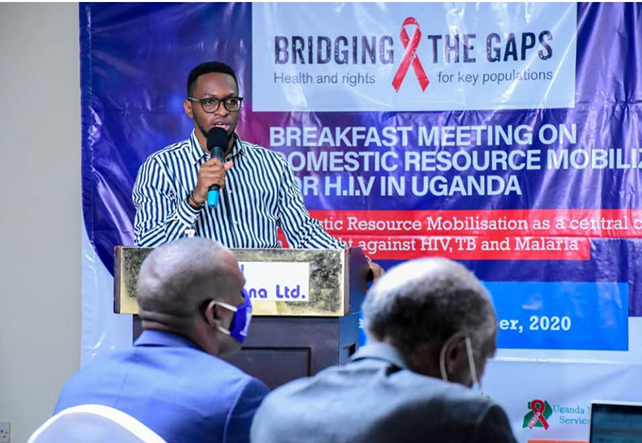
Nicholas Niwagaba, UNYPA executive director said securing increased funding from donors and governments especially for HIV treatment and prevention activities is crucial for countries like Uganda, therefore, domestic investments must scale up alongside donor country funding, and civil society will play an important role in budget advocacy.
Dr Nelson Musoba, director general, Uganda AIDS Commission, said, achieving the set 95, 95, 95 targets in our new National HIV and AIDS Strategic Plan 2020/21-2024/25 is dependent on locally mobilizing adequate resources.
"Adequate resources are critically needed to implement the high impact interventions proposed in the strategic plan, therefore domestic resource mobilization for HIV and AIDS in Uganda is a timely important topic," he said.
The ongoing global health shifts with competing priorities faced by the international community will have an adverse impact on the progress we are making towards ending AIDS as a public health threat by 2030.
As government, it is within our interest and mandate to generate adequate domestic resources for HIV&AIDS, and other key diseases in the country - Malaria, TB among others.
Musoba revealed that president Museveni recently endorsed guidelines for mainstreaming HIV and AIDS in all public sectors, as one of the ways to sustainably respond to the epidemic in the country.
In these guidelines, resourcing the response is central; wherein all sectors and District Local Governments are directed to allocate at least 0.1% of their annual budgets, excluding wages, pension and transfers to HIV and ADS interventions.
"Through this innovation, for example in FY 2020/21 alone, over sh38 billion has been allocated to HIV and AIDS interventions by government sectors. Generating sh38 billion annually to the response is clearly a positive step we are making in the right direction," he said.
He said the government is working on innovative approaches to further strengthen partnerships with the private sector which is currently implementing a highly innovative domestic resource mobilization initiative - the One Dollar Initiative (ODI), the first of its kind and a success story to talk about as a country.
"I implore you all to be part of this initiative and mobilize individuals and institutions within your reach to contribute to this initiative. Uganda AIDS Commission is working closely with the ODI secretariat to add vigour to the ODI, and soon, in partnership with the private sector, a platform will be established comprising of all ODI stakeholders to provide progress update to the public on a regular basis," Musoba revealed.
He empathised that domestic financing is the bedrock of the national HIV and AIDS response, especially in the era uncertainties surrounding external resources which we have heavily relied on over the 30 years of the epidemic.
Government is committed to making incremental allocations to the HIV&AIDS response - which we have been doing over the years.
Simultaneously, the government continues to find ways to get adequate domestic resources for the response.
On behalf of the government of Uganda, he thanked UNYPA for taking the lead in organizing the breakfast meeting which he said has strengthened their partnership to collectively fast track the response to the AIDS epidemic.