
ICT sector facing a shortage of industry-ready skills, experts say
Onek said his experience interviewing fresh graduates has shown that many have academic qualifications but lack the practical skills required by the industry.
Japotech Solutions Managing Director Paul Onek speaks during the training. (Photo by Richard Sanya).
__________________
Uganda’s telecommunications and wider ICT sector is facing a shortage of industry-ready skills despite the growing number of graduates entering the job market, according to Japotech Solutions Managing Director Paul Onek.
Onek made the remarks during an Advanced Telecom Technologies Training held on Saturday, September 19, 2026, at Japotech Solutions offices in Ntinda, Kampala.
The training brought together about 25 participants, including fresh graduates, ICT professionals and students from different universities and companies. Some participants attended online.
Onek, who said he has 21 years of experience in the industry, noted that there is a misconception that Uganda has few jobs in the ICT and telecom sectors.
“We don't lack jobs, but we lack the skills,” he said.
He said companies require skilled workers in areas including core networks, radio access networks, tower construction, transmission technologies and cloud computing.
“They are, of course, academically maybe fully baked, but in terms of the industry skills required, they're half baked,” he said.
The training covered the evolution of mobile telephony from 2G to 6G, artificial intelligence, cloud computing, low-Earth-orbit satellite technologies and fibre optic technologies, including passive optical networks, GPON and FTTX.
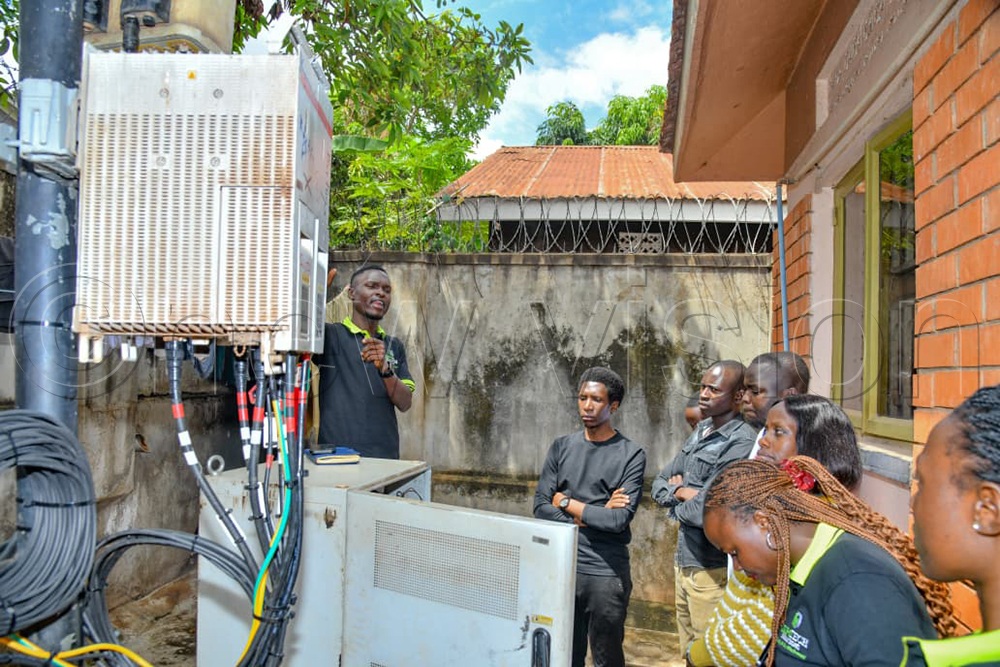
Participants take part in a practical training session led by a facilitator during the Advanced Telecom Technologies Training. (Photo by Richard Sanya).
‘Opportunity to learn’
For Queen Pinklen Asasira, an aspiring software engineer and student at Victoria University, the training offered an opportunity to learn about areas outside her primary field.
She said the sessions on fibre optics, AI, cybersecurity and cloud computing were particularly useful, noting that she had limited knowledge of fibre technologies.
“As a Software Engineering student, this was really so much for me to learn from,” she said.
Ronald Okello, a Bachelor of Information Technology graduate, said the practical component of the training was particularly relevant to his work.
He said his university education had given him theoretical knowledge of several technologies, but he now applies some of them at work, including microwave technology, routers and switches.
“Even with the knowledge I have accumulated, this training was very important to me,” he said.
For Alex Namulinda, a 2025 Electronics and Communication Engineering graduate from ISBAT University, the training helped bridge the gap between what he had studied and practical telecom operations.
He said the fibre session helped him understand how connectivity moves from its source through service providers to the end user.
Onek said Japotech intends to expand the training programme to reach more young people and develop a larger pool of experienced telecom and ICT professionals.
He said the long-term goal is to establish a telecom training academy capable of supporting skills development in Uganda and beyond.