
Uganda reaffirms strong political, commercial ties with India
Addressing investors and exhibitors, the outgoing state minister for trade, David Bahati, described Uganda’s relations with India as “very stable and very solid,” noting that the partnership continues to play a major role in Uganda’s economic transformation
Outgoing state minister for trade, David Bahati interacting with exhibitors at the Uganda Construction Expo 2026. (Photo by Nelson Kiva)
___________________
Uganda has reaffirmed its strong political and commercial relations with India as government officials and investors called for deeper cooperation in trade, manufacturing, infrastructure development, renewable energy and industrialisation.
This was during the three-day Construction Uganda Expo 2026 hosted at the Uganda Manufacturers Association (UMA) Multi-Purpose Hall in Kampala from May 21 to May 23, 2026.
The expo, which was co-hosted with the Power Energy and Solar Expo 2026, attracted exhibitors and investors from more than 10 countries, including India, China, Kenya, Malaysia and the Philippines.
Addressing investors and exhibitors, the outgoing state minister for trade, David Bahati, described Uganda’s relations with India as “very stable and very solid,” noting that the partnership continues to play a major role in Uganda’s economic transformation.
“Events such as this provide an excellent platform to deepen those partnerships further,” Bahati said.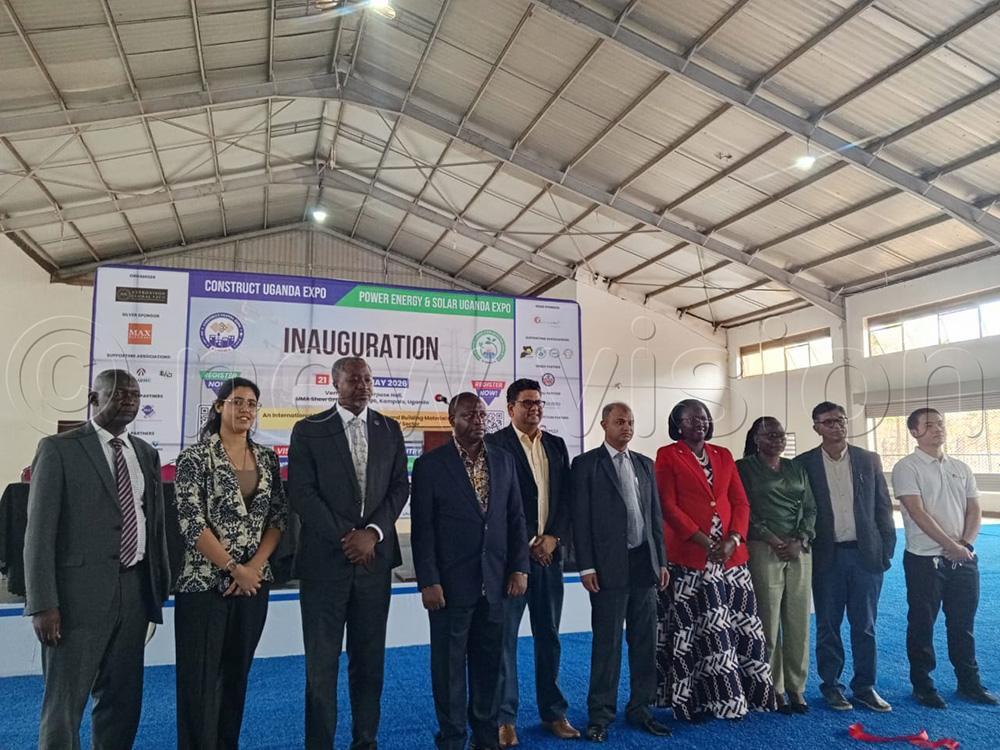
Outgoing state minister for trade, David Bahati posing for a photo with the organisers of the Uganda Construction Expo 2026. (Photo by Nelson Kiva)
Uganda and India officially established diplomatic relations in 1965, three years after Uganda attained independence. Since then, the relationship has steadily expanded through trade, investment, development cooperation, education and technology transfer.
India remains one of Uganda’s largest trading partners and among the biggest sources of foreign direct investment in the country.
Bahati revealed that Uganda currently imports pharmaceuticals worth about $600m annually from India, while also exporting agricultural products such as chilli to the Indian market.
According to data from the Bank of Uganda and India’s Ministry of Commerce, bilateral trade between the two countries has in recent years fluctuated between $1.2b (sh4.5 trillion) and $1.5b (sh5.6 trillion) annually, with India maintaining a strong presence in manufacturing, steel, sugar, banking, agro-processing and telecommunications in Uganda.
The minister also highlighted Uganda’s growing demand for construction materials as the country struggles to address a significant housing deficit.
According to estimates by the lands ministry, Uganda faces a national housing deficit of more than 2.4 million housing units, with Kampala alone accounting for nearly 550,000 units. The deficit continues to widen due to rapid population growth estimated at more than 3% annually and increasing urbanisation.
Bahati said the government is encouraging local manufacturing of construction materials to reduce dependence on imports and lower building costs.
“Uganda imports steel and steel products worth approximately $1b (sh3.7 trillion) annually despite having significant iron ore deposits,” Bahati said.
He added: “To bridge this gap, government has encouraged investment in steel manufacturing plants in areas such as Tororo, Jinja and the Mbale Industrial Park. Companies including Tembo Steels and several Indian-owned manufacturers are investing heavily in Uganda’s steel industry to support local value addition.”
He noted that increased local production of steel, cement and other construction materials would make housing and infrastructure development more affordable while creating employment opportunities for Ugandans.
The construction sector currently contributes between 13% and 18% of Uganda’s Gross Domestic Product (GDP) and employs more than one million people.
The sector remains one of the fastest-growing segments of Uganda’s economy, driven by investments in roads, industrial parks, commercial buildings, energy infrastructure and housing projects.
The Indian High Commission in Kampala also used the expo to reaffirm India’s commitment to supporting Uganda’s industrialisation and infrastructure agenda.
Yogender Singh, the second secretary for political, education and commerce at the Indian High Commission, described the exhibition as timely and important for Uganda and the wider East African region.
“India and Uganda continue to enjoy long-standing and friendly relations rooted in historical ties, people-to-people connections and expanding economic cooperation,” Singh said.
He noted that Indian companies have increasingly played a major role in Uganda’s manufacturing, pharmaceuticals, agriculture and ICT sectors.
Singh added that Uganda’s rapid urbanisation and growing energy demand present enormous opportunities for investment in construction, solar energy, power transmission and electric mobility.
“India has developed strong capabilities in affordable infrastructure solutions, renewable energy technologies, solar applications and energy services. Events such as this provide an excellent platform to deepen those partnerships further,” he said.
The exhibition showcased products and technologies in construction machinery, building materials, renewable energy systems, electric mobility, batteries, power transmission and smart infrastructure.
Trushar Upadhyay, honorary advisor of the Federation of Indian Chambers of Commerce and Industry (FICCI), said Uganda is increasingly positioning itself as one of East Africa’s most promising destinations for investment and industrial growth.
“Uganda’s focus on infrastructure development, housing, urbanisation, energy access, industrialisation and sustainable growth is creating major opportunities for investors and businesses worldwide,” Upadhyay said.
He observed that the country’s expanding infrastructure projects, including roads, airports, industrial parks and housing developments, continue to drive demand for construction and renewable energy solutions.
Uganda’s infrastructure ambitions are largely anchored in Vision 2040, a government development blueprint that seeks to transform Uganda into an upper middle-income economy through industrialisation, improved transport systems, energy expansion and urban development.
According to the National Planning Authority, Uganda’s urban population is projected to rise from about 27% currently to nearly 50% by 2040, increasing pressure on housing, transport and energy infrastructure.
Kiara Binta Nkuranga, president of the Uganda National Association of Builders, Suppliers and Engineering Contractors (UNABSEC), said the expo came at a critical time when Uganda is grappling with rising housing demand and rapid urbanisation.
Meanwhile, Dr Ezira Muhumuza, executive director of UMA, said government reforms have made access to both primary and secondary construction materials easier, accelerating growth in the sector.
“Construction in Uganda is growing and becoming cheaper, and therefore more houses are coming up,” Muhumuza said.
Mansi Gaur, spokesperson for Max Hardware and Tools Limited, one of the expo sponsors, also praised Uganda’s rapid growth in construction, urban development and renewable energy.
She said such exhibitions are important in connecting manufacturers, investors, technology providers and policymakers while strengthening regional business partnerships.